How St. Louis Rescued an Aging Water System with Digital Twin Technology
The city’s pipes were buried and breaking. Then they built a virtual version to see the future.

This is a repost from my Bridging the Gap LinkedIn newsletter. If you read it on LinkedIn, thanks for reading! If you haven’t read it yet, thanks for checking it out here!
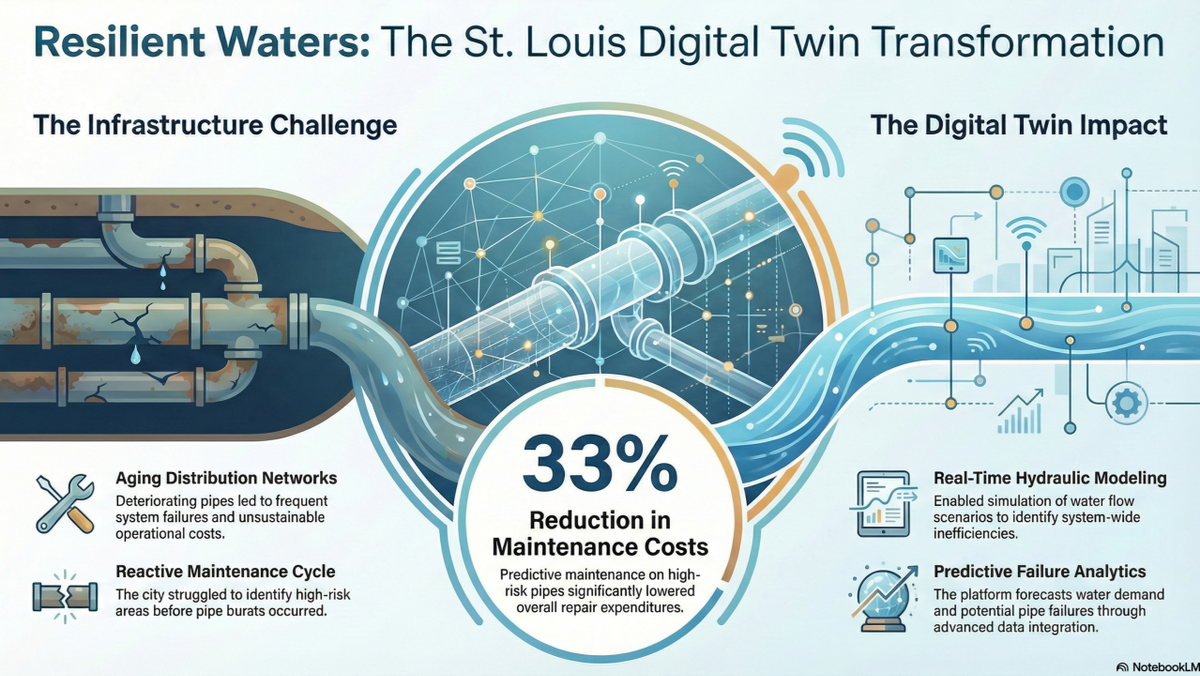
For years, St. Louis was stuck fighting a battle it couldn’t win. The city’s water pipes, buried and forgotten, kept breaking down. Every time a pipe burst, it meant more money spent, more chaos, and more lives disrupted. The old way of doing things, fixing problems only after they broke, just wasn’t working anymore.
Something had to change. St. Louis decided to try something new: building a digital version of its water system. Instead of waiting for things to go wrong, the city wanted to see problems coming. This wasn’t just a tech upgrade. It was a whole new way of thinking, turning hidden risks into something you could actually see and manage.
At the center of this change is a digital backbone that connects the real world to the virtual one. The city used the Asset Administration Shell (AAS) as the main source of truth for everything in the system. (Cavalieri & Gambadoro, 2024)
With the AAS, St. Louis could finally organize all its scattered information, from the details of a single pump to the pressure in a main pipe, into one place. The system brought together three key building blocks:
- Hydraulic Modeling: The engine of the system, simulating water flow and distribution in real-time. It allows engineers to maintain a high-fidelity representation of the network’s behavior under varying demand loads.
- Spatial Foundation (GIS and BIM): The system leverages Geographic Information Systems (GIS) for spatial context and Building Information Modeling (BIM) concepts to create a comprehensive digital inventory of every physical asset.
- Maturity Level 3 Implementation: Right now, St. Louis’s system runs at what experts call Maturity Level 3. That means it’s powered by real-time data, but it can’t yet control the pipes directly from the computer. (Digital Twins for Managing Water Infrastructure, 2024) The city has made big strides, but there’s still room to grow.
The Sensory Network: Building the “Physical Twin” Interface
To make the system come to life, St. Louis installed sensors throughout its water network. At first, these sensors just sent information one-way —> from the pipes to the computer. But as data began to flow in, the city’s digital model became more than just a map. It turned into a living, breathing twin of the real thing.
The city uses advanced IoT communication interfaces, including LoRa, NB-IoT, and 5G/4G cellular networks, to ensure continuous connectivity. (Hoeller et al., 2020) The sensory network includes:
- Level Sensors: Tracking reservoir and tank volumes to manage supply.
- Pressure Sensors: Identifying fluctuations that signal a high probability of imminent pipe failure.
- Flow Sensors: Measuring volume to pinpoint inefficiencies and “non-revenue water” loss.
- Quality Sensors: Monitoring chemical balance and safety across the distribution spectrum.
The real magic of St. Louis’s digital twin lies in how it handles the amount of information pouring in. It doesn’t just collect data and let it sit. Instead, it puts everything together to give the city a live look at what’s happening underground, right now.
With smart analytics and machine learning (i.e., predictive maintenance), the system can spot trouble before it happens. Engineers can test “what if” scenarios, such as a major storm or a major pipe break, before disaster strikes. This way, the city knows exactly which pipes need attention, long before they fail.
St. Louis’s new system isn’t just a test run. It’s working, right now, in the real world. And the results have been huge! Both in savings and in how the city runs day to day.
- Maintenance costs dropped by a third. By fixing problems before they broke, St. Louis stopped wasting money on last-minute repairs. (Rodríguez-Alonso et al., 2024)
- The city could finally see which parts of the system were most at risk and spend money where it mattered most.
- Other cities saw small improvements, but St. Louis set a new standard. By using real-time data at every step, the city raised the bar for what’s possible in water management. (How St. Louis MSD and Aquasight Are Future-Proofing Infrastructure Planning with Best Practice Asset Management Digital Workflows, 2025)
A New Standard for Smart Cities
St. Louis’s story is a lesson for every city trying to get smarter. The technology is ready, but there’s still a major challenge: getting everyone on board and ensuring the system works for the whole community.
Still, St. Louis has shown what’s possible. By making its water system visible and manageable, the city is leading the way toward a more resilient future. The pipes may be out of sight, but the data is front and center, and that’s what makes all the difference.
References
Cavalieri, S. & Gambadoro, S. (2024). Digital Twin of a Water Supply System Using the Asset Administration Shell. Sensors 24(5). https://www.mdpi.com/1424-8220/24/5/1360
(2024). Digital Twins for Managing Water Infrastructure. WaterWorld. https://www.waterworld.com/water-utility-management/smart-water-utility/article/14173219/digital-twins-for-managing-water-infrastructure
Hoeller, A., Sant’Ana, J., Markkula, J., Mikhaylov, K., Souza, R. & Alves, H. (2020). Beyond 5G Low-Power Wide-Area Networks: A LoRaWAN Suitability Study. arXiv:2002.08256. https://doi.org/10.48550/arXiv.2002.08256
Rodríguez-Alonso, C., Pena-Regueiro, I. & García, Ó. (2024). Digital Twin Platform for Water Treatment Plants Using Microservices Architecture. Sensors 24(5). https://www.mdpi.com/1424-8220/24/5/1568
(September 10, 2025). How St. Louis MSD and Aquasight Are Future-Proofing Infrastructure Planning with Best Practice Asset Management Digital Workflows. NACWA. https://www.nacwa.org/news-publications/the-water-voice/2025/09/11/how-st.-louis-msd-and-aquasight-are-future-proofing-infrastructure-planning-with-best-practice-asset-management-digital-workflows