From Apollo 13 to the Mirror World: Why Your Business Needs a Digital Heartbeat
How NASA’s "physical twin" evolved into an AI-driven mirror world that’s redefining industrial strategy

This is a repost from my Bridging the Gap LinkedIn newsletter. If you read it on LinkedIn, thanks for reading! If you haven’t read it yet, thanks for checking it out here!
We’re surrounded by more data than ever, but most of us are still searching for real insight. The Internet of Things has wired up the world, but all that sensor data? It’s just noise until we give it shape and meaning.
The Digital Twin solves this by providing a digital representation of a physical entity, bridging the gap between raw bits and actionable business strategy. It is not a static 3D model; it is a living virtual counterpart that duplicates the status, behavior, and environment of its physical twin.
By providing this digital heartbeat, organizations move from reactive firefighting to a forward-looking state where they can simulate, predict, and improve operations in a “mirror world” before touching a single piece of hardware.
The “Accidental” Hero: A Concept Born in the Stars
The Digital Twin did not begin in a silicon lab, but as a physical safety net at NASA. During the 1970 Apollo 13 mission, engineers famously used a physical “twin” of the spacecraft on Earth to troubleshoot a life-threatening explosion. By testing solutions on the ground-based replica, they developed the makeshift air purifier that saved the crew. (Apollo 13 Crew Installing “Mail Box” for Purging Carbon Dioxide From Lunar Module—April 14, 1970, 2020)
The transition from physical to digital was envisioned in David Gelernter’s 1991 book Mirror Worlds, which predicted a real-time virtual copy of daily life. However, it was the manufacturing sector that eventually codified the discipline. (Digital Twin: Origin to Future, 2024)
Michael Grieves informally introduced the concept of the Digital Twin in his product life-cycle management (PLM) presentation ‘Conceptual Ideal for PLM’ at the University of Michigan in late 2002.” (Grieves & Vickers, 2017, pp. 175-200)
By 2010, the NASA roadmap formally named the “Digital Twin,” defining it as a multi-physics, multi-scale simulation that integrates high-fidelity modeling with real-time situational awareness. (Shafot et al., n.d.)
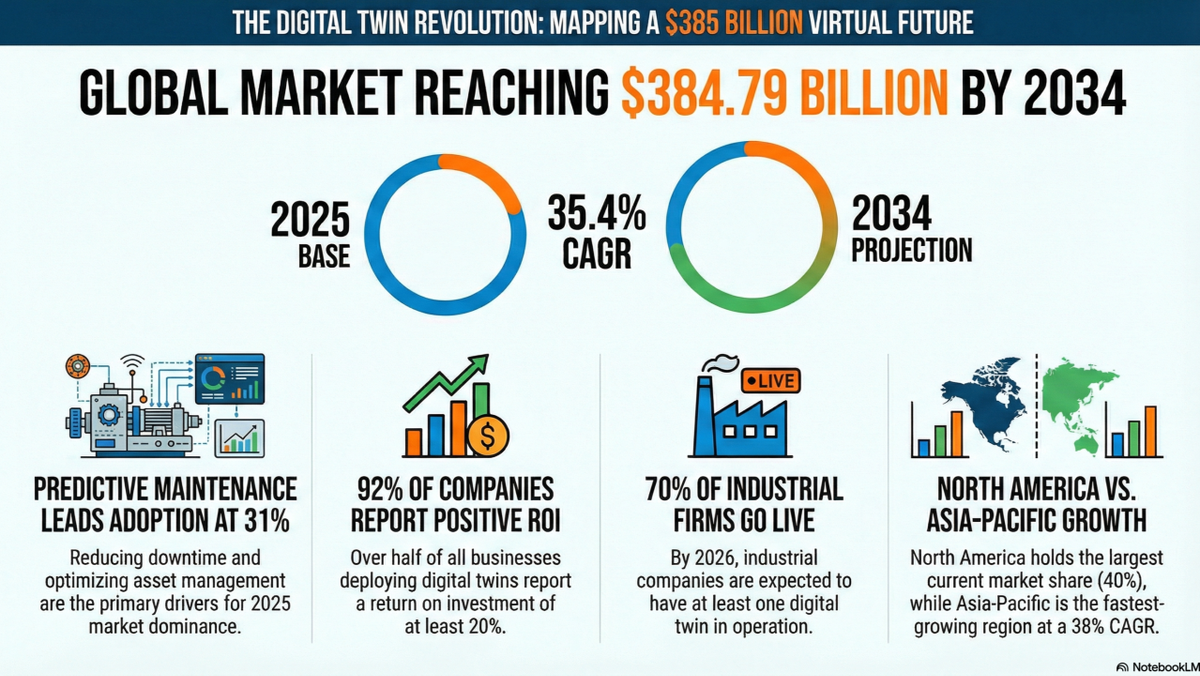
The $15 Billion Milestone and Beyond
What started as a way to keep astronauts safe has now become a necessity for any business that wants to stay ahead. Digital twins aren’t simply a trend. They’re the new baseline for anyone who wants to compete. (Division, 2024)
Quick Stats:
- Market Milestone: The global Digital Twin market reached a valuation of USD 15.66 billion in 2023.
- Velocity: The sector is expanding at a Compound Annual Growth Rate (CAGR) of 37.87%.
- Adoption Rate: A Gartner survey indicates 62% of IoT-using companies are currently implementing or planning their twin strategies.
- Operational Impact: The International Data Corporation (IDC) reports a 30% improvement in manufacturing cycle times for critical processes among early adopters.
The Rail and Port Revolution: Managing Linear Assets
Innovation isn’t stopping at the factory floor. Now it’s connecting to the long, winding networks—railways, tunnels, and other massive systems that used to be impossible to manage because their data was scattered and siloed.
Ports and railways are using digital twins to get leaner and smarter. Barcelona and Rotterdam have already cut their energy use by almost a quarter. Faro Barcelona ends 2024 with a 24% reduction in emissions relative to 2019 and 2025 (Alnaser et al., 2024). With a digital thread tying all the data together, operators can keep processes running smoothly, even in risky environments, without shutting down. In the UK, engineers now use a digital twin of the Severn Tunnel to solve problems virtually, keeping trains moving and costs down. (Network Rail Creates Digital Twin of Historic Severn Tunnel, Revolutionizing Maintenance, 2025)
Digital twins aren’t just for new tech; they’re helping us protect the past, too. Researchers are using them to figure out how old buildings are holding up, even when there are no blueprints left. By combining what we know about how these places were built with live data, we can preserve history for future generations. (Vuoto et al., 2023)
The Blueprint for a Mirror World Economy
But there’s a catch. Most companies still keep their data locked away in separate departments, so nothing connects. To break down these walls, some innovators are using simple tools, like LEGO bricks, to show how everything could fit together in a smarter world.
The “LEGO method” demonstrates how sectors such as Energy, Water, and Mobility can interact via the FIWARE Context Broker. This LEGO approach makes it easy to see how energy, water, and transportation can finally talk to each other. When systems connect, you move from isolated projects to a bigger, smarter strategy. To make sense of it all, leaders use a five-part model to sort out what each digital twin can do.
Grieves and Vickers introduced the concept of a Digital Twin Aggregate (DTA), which aggregates the data of Digital Twin Instances (DTIs) to derive universally applicable predictions and recommendations.” (Grieves & Vickers, 2025)
AI: The Brains Behind the Digital Twin
Artificial intelligence is what makes digital twins smart. With the right kind of neural networks, these systems can spot problems before they happen, even when there isn’t much data to go on.
Technical research shows that although a regular NN performs poorly and exhibits high variability, a Partial Differential Equation (PDE) informed Physics Informed Neural Net (PINN) yields the most stable predictions for bending moments (M_x, M_y). By enforcing physics-based constraints, such as boundary conditions, a twin can achieve greater intelligence with fewer sensors. (Martinez et al., 2025)
This is how a digital twin grows up. It goes through three main stages:
- Real-time capability: Tracking the physical entity through operational and engineering data.
- Evolution: Holding the current knowledge throughout the entire life cycle.
- Functionality: Deriving autonomous solutions, performance optimizations, and future predictions.
The Real Question: Does Your Business Have a Pulse?
Switching to digital twins isn’t simply about buying new tech. It’s about changing how you work, moving from putting out fires to seeing what’s coming next. In this new world, the winners will be the ones who can actually see what’s happening in real time. If you don’t have a digital twin, you’re flying blind. The real question isn’t if you need one, it’s whether your business can survive without it.
References
(April 2, 2020). Apollo 13 Crew Installing “Mail Box” for Purging Carbon Dioxide From Lunar Module—April 14, 1970. NASA. https://www.nasa.gov/image-article/apollo-13-crew-installing-mail-box-purging-carbon-dioxide-from-lunar-module-april-14-1970/
(2024). Digital Twin: Origin to Future. https://research.tus.ie/en/publications/digital-twin-origin-to-future/
Grieves, M. & Vickers, J. (2017). Digital Twin: Mitigating Unpredictable, Undesirable Emergent Behavior in Complex Systems. Complex Systems Engineering: Theory and Practice, pp. 175-200. https://arc.aiaa.org/doi/10.2514/6.2017-0130
Shafot, M., Conroy, M., Doyle, R., Glaessgen, E., Kemp, C., LeMoigne, J. & Wang, L. (n.d.). NASA Modeling, Simulation, and Information Technology Processing Roadmap. https://www.emacromall.com/reference/NASA-Modeling-Simulation-IT-Processing-Roadmap.pdf
Division, N. B. (December 31, 2023). Why does the world (and NASA) need digital twins?. NASA. https://science.nasa.gov/biological-physical/why-does-the-world-and-nasa-need-digital-twins/
Alnaser, A. A., Maxi, M. & Elmousalami, H. (2024). AI-Powered Digital Twins and Internet of Things for Smart Cities and Sustainable Building Environment. Applied Sciences 14(24). https://www.mdpi.com/2076-3417/14/24/12056
(December 5, 2025). Network Rail Creates Digital Twin of Historic Severn Tunnel, Revolutionizing Maintenance. Construction Focus. https://construction-property.com/network-rail-creates-digital-twin-of-historic-severn-tunnel-revolutionizing-maintenance/
Vuoto, A., Funari, M. F. & Lourenço, P. B. (2023). On the Use of the Digital Twin Concept for the Structural Integrity Protection of Architectural Heritage. Infrastructures 8(5). https://www.mdpi.com/2412-3811/8/5/86
Grieves, M. & Vickers, J. (2025). Harnessing hybrid digital twinning for decision-support in smart infrastructures. Data-Centric Engineering 6. https://www.cambridge.org/core/journals/data-centric-engineering/article/harnessing-hybrid-digital-twinning-for-decisionsupport-in-smart-infrastructures/2EEAE80A69096CF8D2730FAE891DD598
Martinez, Y., Rojas, L., Peña, A., Valenzuela, M. & Garcia, J. (2025). Physics-Informed Neural Networks for the Structural Analysis and Monitoring of Railway Bridges: A Systematic Review. Mathematics 13(10). https://www.mdpi.com/2227-7390/13/10/1571