The Bohemian Swarm AI Podcast
A recording by Thomas Ott

Thank you for tuning in! The video is raw, but the podcast notes below are AI-generated from the transcript.
“The introvert with AI is a fighter jet”
The episode kicks off with a meme that’s been rattling around Thomas’s head: the difference between a boss (whipping people to push a cart) and a leader (pulling it from the front) — and a third figure, the introvert with AI, flying solo like a fighter jet.
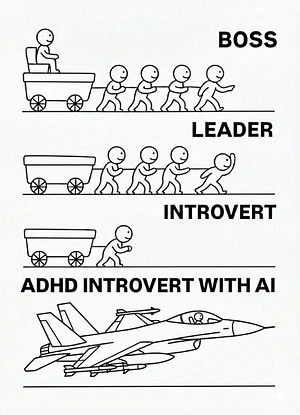
The point: AI is collapsing the gap between expertise and output. You no longer need deep domain training to do sophisticated work — if you know how to harness AI with rigor, method, and governance, you can build yourself the equivalent of a world-class expert on demand. Skills, agents, and reasoning models have replaced the need to write endless prompts from scratch.
As Tom put it, this shift from raw large language models to reasoning models “changed the whole game” — and set the stage for the agent-based workflows both hosts now build with daily.
Why Jess is obsessed with causal modeling — and why “Grok-y Grok” gets it right
The conversation’s deepest thread: the difference between correlation and causation — and why it matters so much for AI’s next phase.
Jess, who came up through Wall Street, applied econometrics, and NGO impact assessment, breaks it down simply: correlation tells you two things happened together. Causation tells you, with mathematical certainty, why. It’s the difference between guessing a storm knocked down a tree branch and actually mapping the full set of forces that caused it to fall.
That distinction is why Jess is drawn to Grok’s approach — reportedly retrained at the base layer using its own cleaned historical data with causal reasoning built in, rather than just pattern-matching probability. The tradeoff: it’s expensive, it took time, and it apparently runs with a higher hallucination rate. But the payoff, in Jess’s view, is a model with more discernment — reasoning that feels less like statistical guesswork and more like genuine understanding of cause and effect.
The bigger stakes, per Jess: causal methods have been used in economics and policy for decades (that’s literally how the Fed forecasts inflation). The real opportunity now is using AI to apply that same rigor at scale — to health outcomes, sustainability, economic mobility — with actual measurable, monitorable certainty instead of best-effort correlation.
The model landscape is moving too fast to gatekeep
Both hosts riffed on the sheer velocity of the open model ecosystem right now — Kimi, Grok, Claude, NVIDIA’s Nemotron family, and “millions of models on Hugging Face,” with new foundational releases seemingly every week.
Jess’s take: this is a feature, not a chaos problem. Keeping the barrier to entry low right now — while we’re still early — matters, because once AI scales further, “it’s anybody’s game.” Better that a 13-year-old in a home lab is building the next breakthrough than a handful of gatekeepers controlling all of it. Jess is currently experimenting with agent swarms built on smaller Nemotron models — orchestrating specialized agents (one as “the brain,” one as a coding agent) to work as a coordinated team.
Thomas shared a real example: using Claude/Cowork to push through a stalled personal project — an open-source hydrology and stream-gauge flood-forecasting repo — turning what would’ve been weeks of scattered nights into a few focused hours.
Do we still need to teach data science — or just teach people to check the machine?
A genuinely thoughtful detour: Thomas’s son is choosing whether to minor in data science, given that LLMs and agents can now execute most of the mechanics faster than a human ever could.
The hosts land on a nuanced answer — you still need to understand the methodology, not to compete with the machine on execution, but so you can direct it, evaluate its output, and know when something’s gone off the rails. It’s the same argument once made about calculators in engineering school: critics said they’d make students dumber; instead, they turbocharged what students could do. Same pattern, new tool.
Data centers: the industry nobody wanted, but everybody needs
The conversation shifts to a topic both hosts clearly care about — the physical infrastructure behind all of this.
A few striking data points raised: data center construction is reportedly propping up the entire U.S. construction sector right now (pull that category out, and the industry would be contracting). Texas alone has 400+ operational data centers with 400+ more planned; Virginia has 600+. Meanwhile, public pushback is mounting — over water usage, noise, fossil fuel consumption, and the way these facilities reshape local communities overnight.
Thomas and Jess don’t paper over the tension. Their read: the underlying issue isn’t AI — it’s a decades-old energy policy failure. We’ve under-invested in sustainable energy production because of where wealth and political incentives have sat since the 1960s and 70s, and AI’s power demands are simply exposing a crack that was already there.
Their proposed fix leans toward nuclear energy — cited as the safest form of energy per unit produced — pointing to Canada’s model of exporting nuclear-generated power (and monetizing medical isotopes as a byproduct) to help power places like New York City. Their pitch: universities, with existing physics and nuclear programs, public trust, and community ties, are well positioned to lead this build-out in a way that benefits local communities directly, rather than leaving it purely to private-sector data center developers.
“Wake up. Do it yourself. Figure it out.”
The episode’s closing note is more rallying cry than tech talk. Jess’s dad’s line about why American troops won WWII — because they knew how to fix their own tanks when they broke down, while others waited for reinforcements — becomes the episode’s thesis.
The call to action: don’t wait for institutions to hand you the future. Learn the tools, build the thing yourself, and use AI as leverage rather than a replacement for that instinct. As Thomas summarized it: “The future is ours. Let’s build it together.”
What’s next
This was a soft launch — the format is still taking shape. Expect more of these unscripted back-and-forths, shorter highlight clips, and eventually guests from the field (first name floated: the friend behind that open-source hydrology project mention). Episodes will land here on Substack, with clips syncing to YouTube.
Bohemian Swarm is an independent, unaffiliated project — the views shared are personal and don’t represent any employer.