
Digital Twins: When Deterministic Engineering Meets Probabilistic AI
How Digital Twins are finally bridging physics-based engineering and probabilistic AI

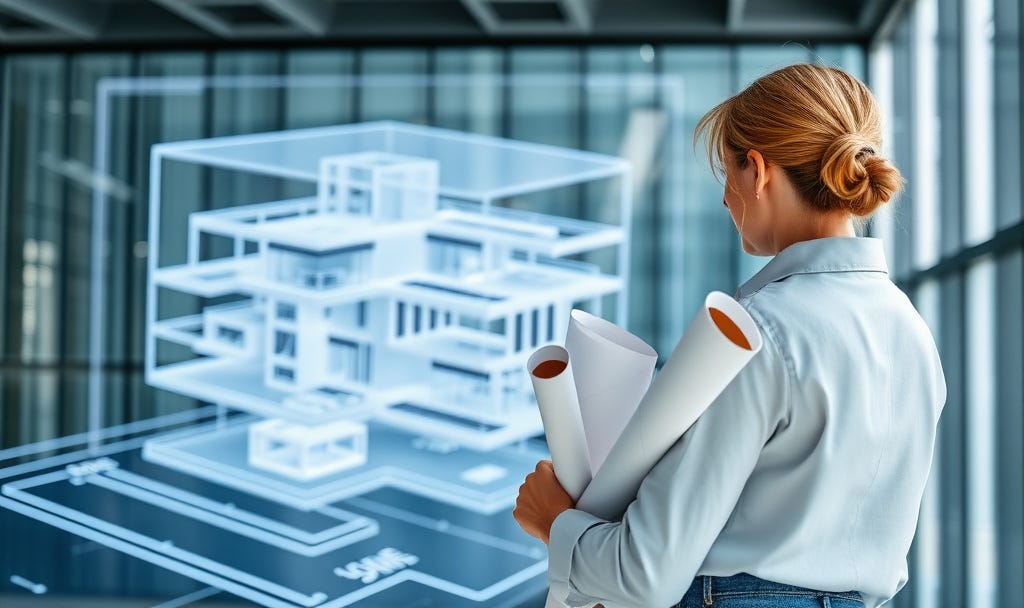
For years, I’ve tried to connect the Architecture, Engineering, and Construction (AEC) community with AI, but it hasn’t been easy. There are some computer vision use cases, but I struggled to find a truly transformative way to use AI in this field.
Perhaps it was my lack of vision, or just the general friction between the two, that was just how they do their work. The AEC community is very deterministic. The same inputs, when applied with the same formula, tend to yield the same output. AI, by itself, is a probabilistic beast; it tends to make “predictions” from a subset of data it has to apply to an unseen set of data.
Even though we can check if these predictions are accurate, they still feel uncertain to the AEC community. As a result, AI and AEC have largely remained separate, each sticking to its own approach.
But things are starting to change.
The Digitalization of the Engineering Field
I still keep my PE license active. It’s more than just paying a fee every two years—I also need to take courses and earn Professional Development Hours (PDH). I enjoy taking courses on Green Infrastructure and learning new ways to keep our water supplies clean and healthy.
Recently, I took a course called “Digitization in the Field of Civil Engineering.” At first, I thought it would just cover how the industry is moving to digital plans and signatures, but it turned out to be much more.
The course explored how the AEC industry is slowly adopting 3D designs to reduce errors, simulate how infrastructure is built over time (also known as 4D), and let clients “walk through” what a finished project will look like.
In short, these 3D models let everyone involved see how a complex project is designed, built, and operated before construction even begins.
Over ten years ago, when I moved from AEC to AI startups, BIM was emerging. Many architects I knew were adopting BIM software for their designs.
BIM reduced errors, enabled 3D design views, and allowed modeling of structural elements within one digital model. It revolutionized infrastructure design.
Despite its benefits, one issue remained: the model became static after the project ended.
Or was it?
AI, Design, Build, Operate, and Maintain (AI DBOM)
The course introduced a term I hear often in my daily work: Digital Twin.
Wikipedia defines a Digital Twin as “…a digital model of an intended or actual real-world physical product, system, or process (a physical twin) that serves as a digital counterpart of it for purposes such as simulation, integration, testing, monitoring, and maintenance.
The AEC community is great at creating Physical Twins and often does some of what Digital Twins do. For example, remote sensors monitor bridges and other key infrastructure, drones and computer vision are used more for inspections, and 3D models are used for simulation, integration, and testing.
Is the AEC community moving toward Digital Twins, whether they realize it or not? And what about using AI? What does a Digital Twin mean in the AI world?
In AI, a Digital Twin is a computational model that represents how a system behaves. It can be abstract, statistical, or agent-based, and is used to simulate outcomes, test decisions, and optimize policies. Unlike 3D design simulations, which are usually deterministic, AI Digital Twins are often probabilistic.
At first glance, they seem different, but I think they have more in common than most people realize.
A 3D model, or Digital Twin, of a building uses many deterministic design methods to define its parameters. An AI Digital Twin, however, lets owners and operators run what-if simulations and stress-test operations before the building is even in use. When additional sensors and data are collected after construction is complete and operations begin, the Physical Twin becomes “alive.”
The boundaries between AI, design, build, operation, and maintenance are blurring.
This convergence means the stakes are high: AEC firms that adopt AI now will drive the new era, and those that hesitate risk being left behind as the industry transforms.
That’s both exciting and a little scary.
Merging the Deterministic and Probabilistic
The real opportunity is not a clash of paradigms, but a synthesis. Deterministic engineering and probabilistic AI work best together, each addressing different needs of modern infrastructure.
Deterministic models define what must be true for an asset to exist safely. Load paths, hydraulic capacity, code compliance, and factors of safety. These are non-negotiable. They are the foundation. AI has no business replacing them.
Probabilistic models answer a different question: What is likely to happen next? They build on top of the physics, not in place of it. These models deal with uncertainty, like changes in weather, usage patterns, human behavior, material wear, and how things change over time.
A Digital Twin that uses both approaches is unique. The deterministic layer sets the boundaries of what’s possible; the probabilistic layer explores what can happen within those boundaries. One ensures safety and accuracy, while the other brings foresight, optimization, and resilience.
This is the connection we’ve been missing.
When AI is grounded in engineering fundamentals like geometry, physics, and constraints, it is no longer vague to engineers—it becomes a decision-support tool rather than a mysterious black box. Similarly, when engineering models go beyond static documents and use real data, they become living systems, not just records of the past.
No, robots won’t be designing bridges, and large language models won’t be signing drawings. But engineers need to realize that an asset’s life doesn’t end at substantial completion. It continues to change, wear down, adapt, and interact with the world in ways that deterministic equations can’t fully capture.
The firms that win will be the ones that:
Treat BIM as a starting point.
Invest in data infrastructure alongside design tools.
Pair licensed engineers with applied AI practitioners
Accept that uncertainty can be modeled and shouldn’t be ignored.
This change won’t be easy. It will disrupt traditional workflows, fee structures, and professional boundaries. But it’s going to happen. This is what the AI DBOM era really looks like.
The question isn’t whether AI belongs in AEC anymore.
The most urgent question facing the AEC industry is whether it will proactively lead the integration of AI, or scramble to adapt after others have already set the terms.