
Is Your Cloud Competition Slaughtering You? Consider This Before A Pivot
If you want to survive, you need a plan. And you need to actually follow through


Trying to build something new amid the dominance of AWS, Azure, and GCP is brutal. Founders lose sleep as cloud giants quickly duplicate innovations, turning products into commodities and squeezing out standalone value.
Why should a customer choose your product when cloud providers offer similar solutions that are cheaper and lower risk? Unless you deliver transformational value, it’s hard to persuade them to choose you.
That’s the trap. The cloud enables users to utilize what they need and turn it off when done. The ever-expanding toolbox reduces reasons to look elsewhere.
Take AutoML as an example. It was once the darling of the machine-learning world. Early entrants did relatively well until cloud providers built or acquired their own “me too” versions. Customers can now simplify and replace vendor (you) subscriptions or licenses with what their cloud provider already offers.
You know the first sign you’re in trouble? Customers start leaving. Revenue drops. By the time you notice, it’s already too late. The clouds have moved in, and your competitors are bleeding out.
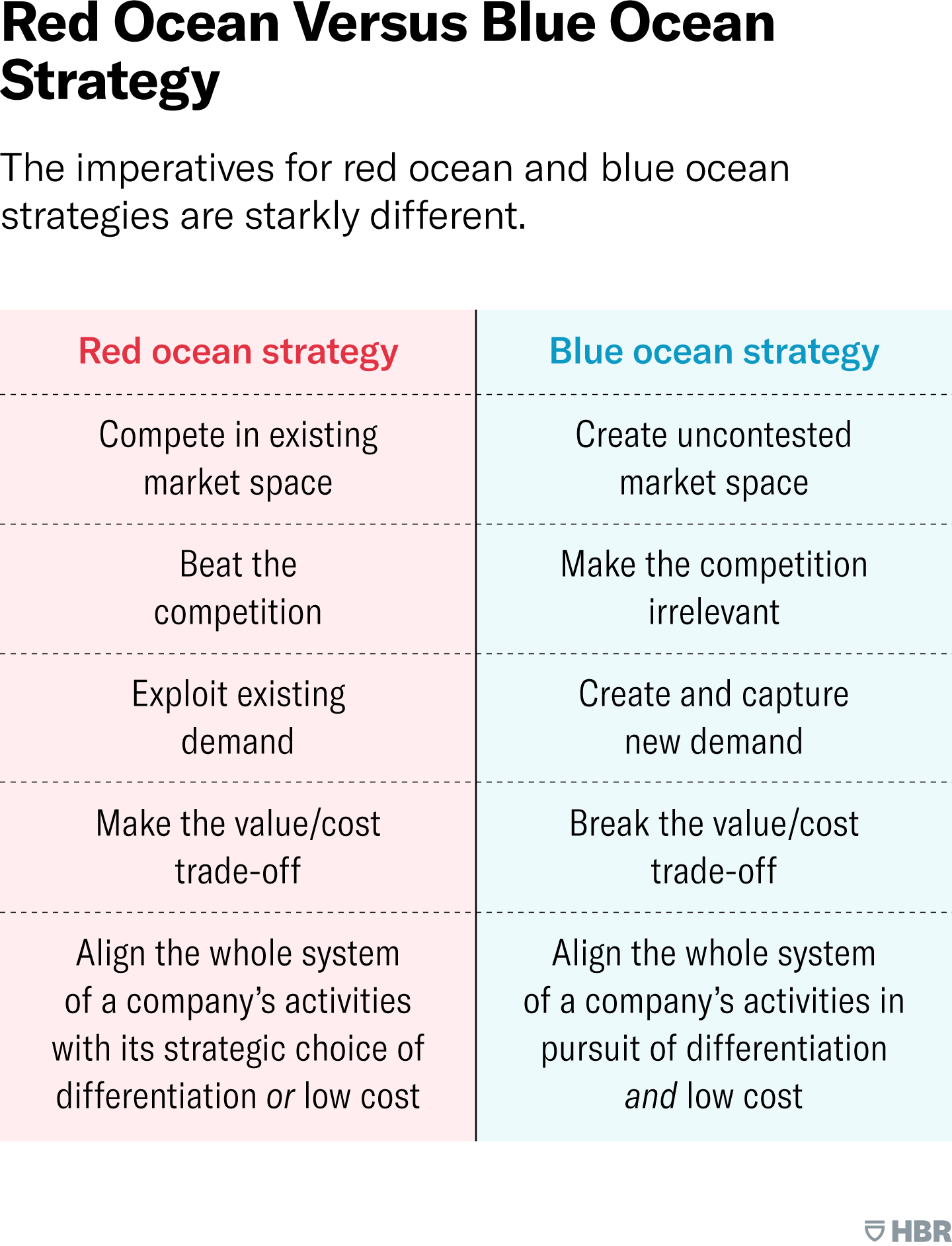
This is what professors W. Chan Kim and Renée Mauborgne call a Red Ocean in their book Blue Ocean Strategy — a market where large players (like cloud providers) gobble up smaller competitors, consolidating the space.
Surviving in a Red Ocean
To survive, you must escape the brutal Red Ocean of direct cloud competition by finding a Blue Ocean—an uncontested space where your strengths make competition irrelevant. A pivot isn’t always the answer, but a strategic shift toward differentiated value may be necessary.
Pivoting is disruptive and risky. Instead, use strategic planning to identify opportunities for value innovation: differentiate your product to provide unique value to customers and reduce internal costs. The goal is to uncover what competitors can’t easily imitate.
In this video, the example was Cirque du Soleil, a circus mixed with theatre. They didn’t reinvent the circus or theatre but created something new and different while cutting costs. By dropping expensive elements like animals or big-name stars, they kept costs low and offered something unique. The result? They created something that their competitors couldn’t emulate. In essence, they took out their competition before they could even compete.
Cloud providers apply the same strategy: use what is needed and build what is wanted. When faced with a copycat product, consider whether that battle is worth fighting.
Strategic Planning
The first step is to sit down with your team and face what your organization is experiencing. Too often, we focus only on immediate competitors and forget to look beyond the horizon for emerging threats.
You don’t need to overcomplicate things. Set a budget. Assign resources. Even a simple SWOT analysis can get the conversation started. Bring real numbers. Leave egos and gut feelings at the door.
Define boundaries clearly. In AutoML, the focus has been on features such as algorithm support, GPU support, ETL handling, and model export. Competition centers around meeting checklist requirements.
Be ruthless. Cut what doesn’t matter. Focus on what makes you different—and cheaper.
Understanding Your Customers
Customers compare cloud offerings, assessing them line by line. The cloud is treated as an operating expense, while alternative solutions are treated as capital expenses. This distinction makes it difficult for most companies to justify buying from you rather than building in the cloud.
Strategic planning should clarify whether your product delivers unique, irreplaceable value or is becoming commoditized as middleware. For example, rather than competing directly in crowded AutoML, consider leveraging your core technology in a completely new application context that cloud providers don’t address.
Value Innovation
The distinction lies in approach: Red Ocean strategies drive up costs by adding features, while Blue Ocean strategies reduce costs by redefining the product.
If Amazon, Azure, or Google have competing AutoML products (and they do), why compete? Instead, strip out the core engine of your AutoML and create a new product that none of the cloud providers offer. Then integrate it into the cloud infrastructure to make it easy to use.
This is not a full pivot. It’s an intentional move to escape commodity competition and stand out with differentiated value.
Go-To-Market (GTM) Strategy
Talking about Red and Blue Oceans is great, but it means nothing without execution. Your go-to-market plan is where you find out if your idea actually works. If it does, you’ll see the numbers go up. Execution is everything.
One way to do this? Offer simple subscription tiers—small, medium, enterprise. Even if the market is crowded, if you keep your costs low, you can win.
I know someone who did this. He automated and streamlined his engineering business, and now he owns a fifth of the US solar engineering market. His secret? Fast turnaround and low costs. The competition can’t touch him.
Final Thoughts
Don’t just watch your revenue disappear—take action now. Gather your team, get strategic, and focus on how you stand out and cut costs. Before you decide to pivot, examine your business closely. Schedule a planning session this week to identify unique value opportunities right in front of you.