
The 1GW Reality Check: Moving from Passive Hype to Active Intelligence
Why the future of AI belongs to engineers who can bridge the $530B compute gap with physical infrastructure

We’ve spent the last three years obsessed with what AI can write. In 2026, we are finally obsessing over AI and how it relates to power, both in what it can power and how much power it uses.
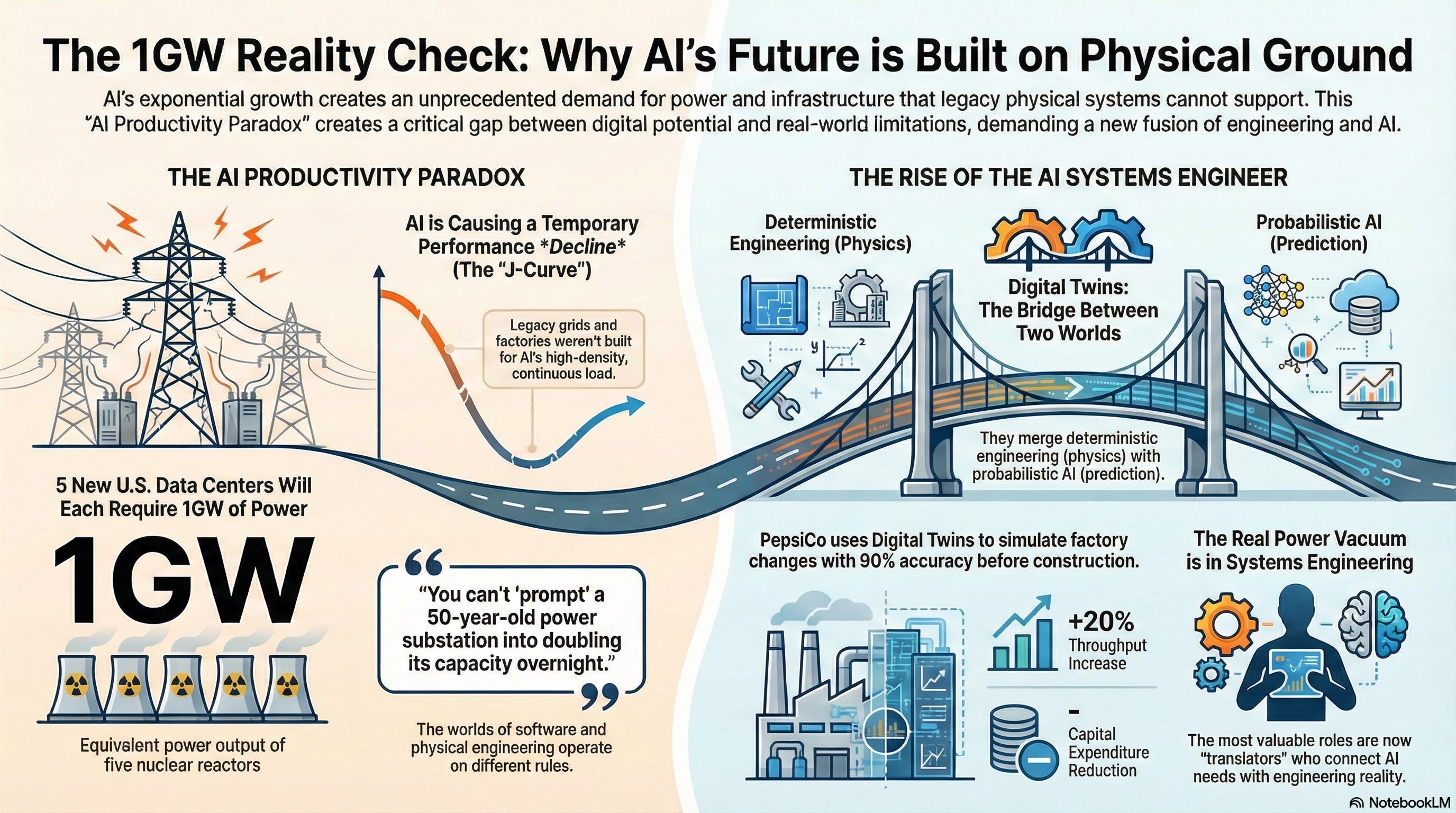
As of January 2026, Big Tech’s AI infrastructure capex has surged to an estimated $530 billion. (Why AI Companies May Invest More than $500 Billion in 2026, 2026) But here is the gap: in the U.S. alone, five massive data centers are coming online this year, each drawing 1 GW of electricity. (Five AI Data Centers to Reach 1 GW Power Capacity in 2026, New Analysis Shows, 2025) That’s the equivalent of a nuclear reactor’s output. (US data centers’ energy use amid the artificial intelligence boom, 2025)
We are hitting the "AI Productivity Paradox." While the market expects AI to instantly accelerate performance, manufacturing and infrastructure firms are actually seeing a temporary decline—the "J-curve." (The ‘productivity paradox’ of AI adoption in manufacturing firms.) Our legacy physical systems—our grids, our factories, and our workflows—simply weren't built for this level of high-density, continuous load. (Data Center Modernization: Transforming the Legacy Infrastructure, 2025)
The Professional Engineer’s Reality Check
As a Licensed Professional Engineer (PE), I’ve spent my career respecting physical constraints. You can’t “prompt” a 50-year-old power substation into doubling its capacity overnight.
This is where the real work happens. The era of “passive simulation” is dead. We are moving toward Active Intelligence.
Beyond the Chatbot: What is Active Intelligence?
To understand the shift, we have to distinguish between where we were and where we are going:
Passive Intelligence (Yesterday): AI as a consultant. It summarizes a PDF or predicts when a machine might break. The human remains the manual actuator.
Active Intelligence (2026): AI as an integrated physical actor. This is the transition to an “Industrial AI Operating System” where the digital model and physical reality are tethered in a closed loop.
Take the recent January 2026 announcement from Siemens and NVIDIA regarding their “Industrial AI Operating System.” They aren’t just making 3D models; they are creating physics-accurate Digital Twin Composers. These systems allow companies like PepsiCo to simulate every conveyor and operator path with 90% accuracy before a single bolt is turned. (PepsiCo Announces Industry-First AI and Digital Twin Collaboration with Siemens and NVIDIA, 2025)
The Power Vacuum: Why “Translators” Own the Future
If you want career leverage in 2026, stop trying to be a better “prompter.” The world has enough of those.
The real power vacuum is in Systems Engineering. The highest-paid and most influential roles are now going to the “translators”—those who can bridge the gap between AI’s massive compute needs and the engineering realities of the grid. (2026 IT Hiring Trends: Workforce Planning Guide, 2025) Even NVIDIA’s leadership has noted that this infrastructure shift is creating a massive “Job Class” for the people who build, wire, and plumb these 1GW environments. (Nvidia CEO Sees AI Data Centers Fueling ‘Six-Figure’ Construction Jobs, 2026)
My Advice: Codify Your Leverage
When systems shift, those who wait for permission lose their leverage.
Build your brand around Standard Operating Procedures (SOPs) for AI integration. When you own the framework for how a complex system is updated and managed, you own the structural power of the organization.
The era of “watching” AI is over. It’s time to lead the engineering of it.
References
“Why AI Companies May Invest More than $500 Billion in 2026.” Goldman Sachs, 2026. https://www.goldmansachs.com/insights/articles/why-ai-companies-may-invest-more-than-500-billion-in-2026 Accessed January 29, 2026
“Five AI Data Centers to Reach 1 GW Power Capacity in 2026, New Analysis Shows.” The Data Center Engineer, November 24, 2025. https://thedatacenterengineer.com/news/five-ai-data-centers-to-reach-1-gw-power-capacity-in-2026-new-analysis-shows/
“US data centers’ energy use amid the artificial intelligence boom.” Pew Research Center, October 23, 2025. https://www.pewresearch.org/short-reads/2025/10/24/what-we-know-about-energy-use-at-us-data-centers-amid-the-ai-boom/
“The ‘productivity paradox’ of AI adoption in manufacturing firms.” MIT Sloan, July 9, 2025 https://mitsloan.mit.edu/ideas-made-to-matter/productivity-paradox-ai-adoption-manufacturing-firms
“Data Center Modernization: Transforming the Legacy Infrastructure.” CIOTechOutlook.com, June 30, 2025. https://www.ciotechoutlook.com/cxoinsight/data-center-modernization-transforming-the-legacy-infrastructure-nid-11814-cid-50.html
“PepsiCo Announces Industry-First AI and Digital Twin Collaboration with Siemens and NVIDIA.” PepsiCo, December 13, 2025. https://www.pepsico.com/newsroom/press-releases/2025/pepsico-announces-industry-first-ai-and-digital-twin-collaboration-with-siemens-and-nvidia
“2026 IT Hiring Trends: Workforce Planning Guide.” Addison Group, 2025. https://addisongroup.com/insights/it-hiring-trends-workforce-planning-guide-2026/ Accessed January 29, 2026
“Nvidia CEO Sees AI Data Centers Fueling ‘Six-Figure’ Construction Jobs.” Realtor.com, January 21, 2026. https://www.realtor.com/news/trends/nvidia-jensen-huang-ai-data-centers-construction-jobs/